
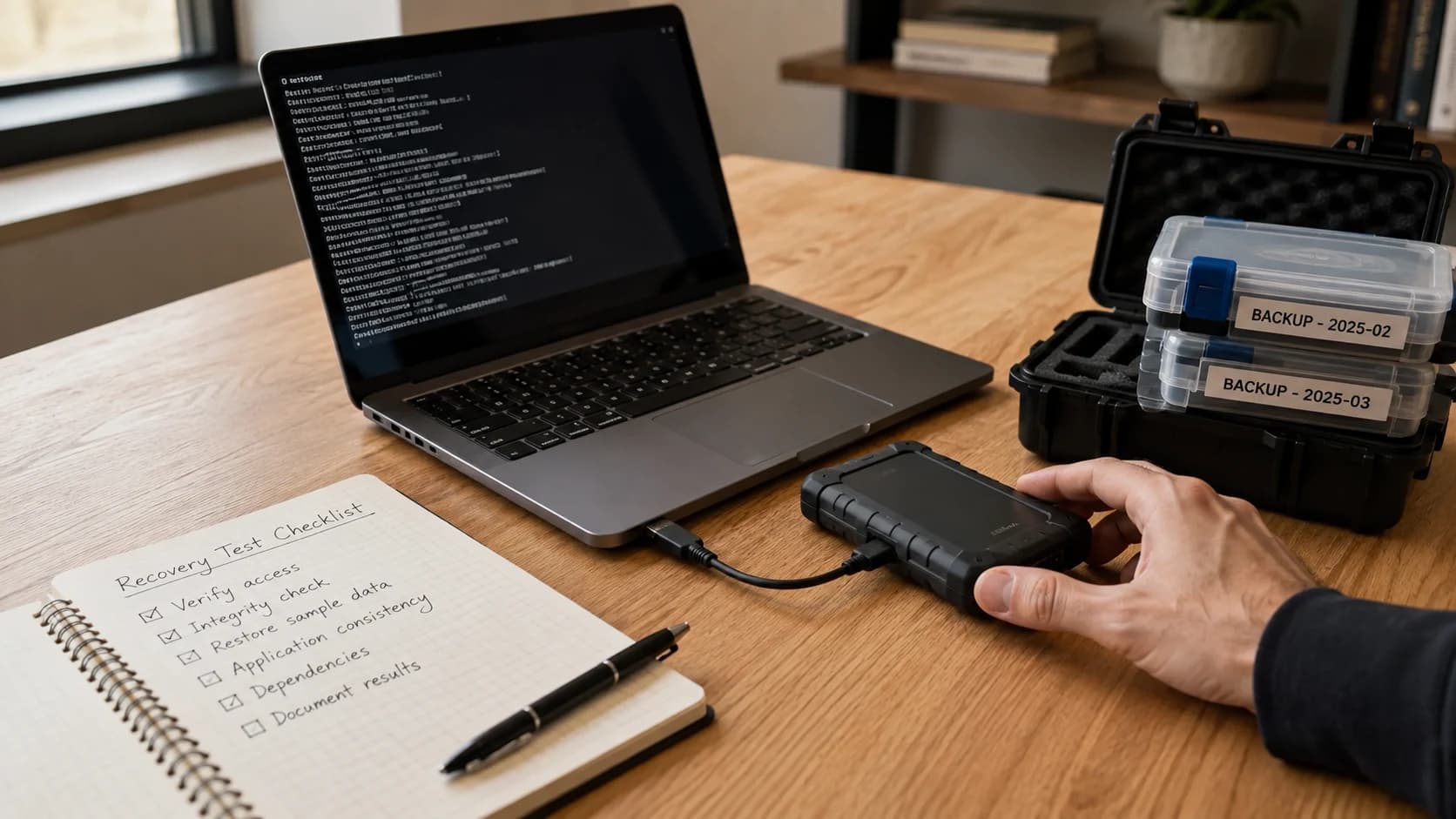
How to Test Backups for Real Ransomware Recovery
A successful backup job proves that data was copied. It does not prove that a business service can be recovered under pressure. Ransomware recovery depends on clean restore points, usable credentials, system dependencies, enough infrastructure, and people who can make decisions while normal administration may be unavailable.
CISA recommends offline, encrypted backups and regular tests of their availability and integrity. A useful exercise goes further by measuring whether the organization can restore an agreed business outcome, not merely recover a file.
Design the test around a business service
Pick one service whose outage has a clear operational consequence. Map its identity provider, DNS, certificates, databases, storage, application hosts, network rules, secrets, vendor connections, and administrator workstations. A restore sequence that ignores these dependencies will fail even when every backup is intact.
Define a clean-room assumption: production credentials may be compromised, the usual management network may be unavailable, and the most recent backup may contain attacker persistence. This makes the exercise a security test rather than a routine disaster-recovery demonstration.
- State recovery-time and recovery-point objectives before the exercise begins.
- Use a segregated target so testing cannot overwrite production or trusted backups.
- Validate application behavior and data consistency with the business owner.
- Record every missing dependency, manual step, and privileged-access delay.
Test integrity, access, and decision-making
Confirm that backup administrators use identities separated from day-to-day administration and that destructive changes require strong controls. Test how recovery keys, break-glass accounts, vendor licenses, and build artifacts are obtained. Then introduce uncertainty: an unavailable operator, a suspected infected restore point, or a failed storage target.
End with evidence. Capture elapsed time, recovered scope, validation results, exceptions, and owners for corrective actions. Repeat the test after remediation; otherwise the exercise documents risk without reducing it.
Put the lesson into practice
- Select one critical service and document its dependency map.
- Restore it into an isolated environment from an offline or immutable copy.
- Scan and inspect the recovered environment before reconnecting trust paths.
- Have the business owner validate function and data accuracy.
- Retest the failed steps after corrective work is complete.
Related Outfaze guidance
- Anti-ransomware services
- Digital forensics and incident response
- Security incident and crisis support
- Managed detection and response
- Incident response plan for small IT teams