
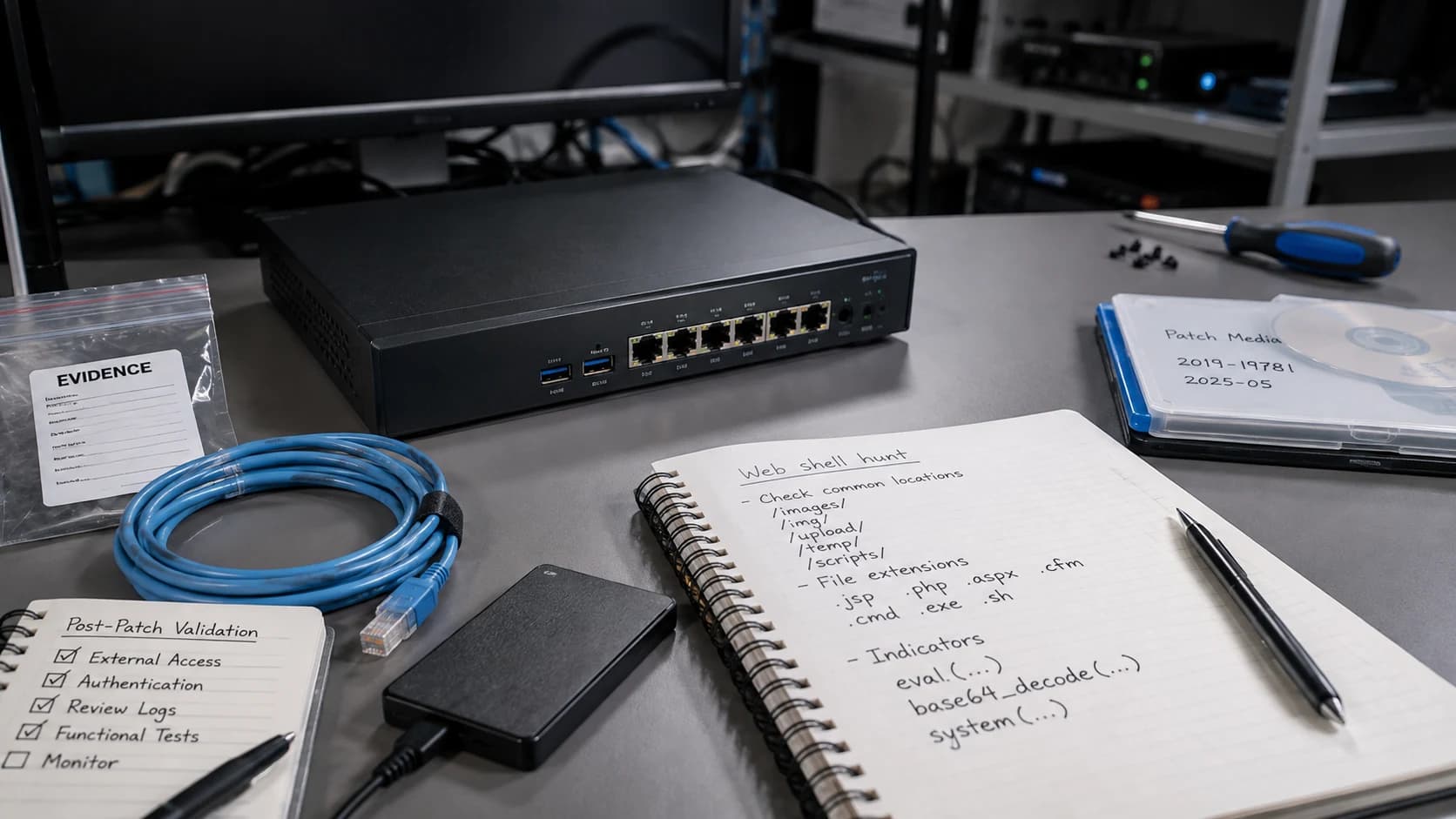
Citrix CVE-2019-19781: Patch and Check for Compromise
CISA's January 2020 advisory described successful compromise of organizations running vulnerable Citrix ADC and Gateway products affected by CVE-2019-19781. The agency emphasized that applying released patches would not remove an attacker who had already established a foothold.
That statement captures one of the most important rules in vulnerability response: remediation changes future exposure; investigation addresses past exposure.
Closing the door did not remove the intruder
Exploit code circulated after initial mitigations were announced, and internet-facing appliances became active targets. Attackers could execute arbitrary code and use the device as an entry point into internal networks.
Organizations needed to identify whether the device was exposed during the vulnerable window, preserve evidence, apply fixes, and look for post-compromise behavior. A green vulnerability scan answered only part of that problem.
Create two tracks for exploited vulnerabilities
The remediation track finds affected assets, applies supported fixes, validates versions, and closes exposure. The incident track preserves logs, checks integrity, hunts for persistence and lateral movement, and scopes credentials and connected systems.
Run both tracks together when exploitation is known or likely. Store gateway logs centrally, maintain an owner for every public service, and define when a vulnerability ticket must become an incident.
- Record the exposure window, not only the patch date.
- Use external discovery to find forgotten appliances.
- Keep evidence before rebuilding.
- Escalate positive findings into credential and network scoping.
Put the lesson into practice
- Inventory affected Citrix products and public exposure.
- Preserve logs and configuration evidence.
- Apply fixed versions and validate every node.
- Hunt for persistence and internal activity.
- Document the threshold from vulnerability to incident response.
Related Outfaze guidance
- Practical vulnerability management lifecycle
- Patch management
- Vulnerability assessment
- Managed detection and response
- Digital forensics and incident response